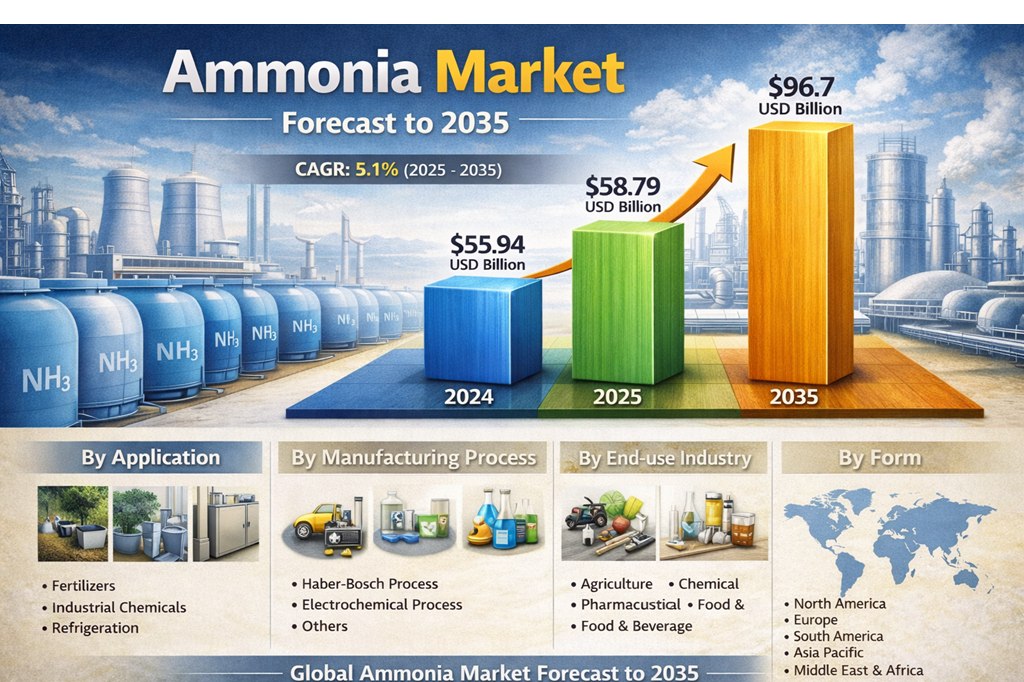
According to a comprehensive analysis by Market Research Future, the global Ammonia Market was valued at USD 55.94 billion in 2024 and is projected to grow from USD 58.79 billion in 2025 to USD 96.7 billion by 2035, advancing at a compound annual growth rate (CAGR) of 5.1% throughout the forecast period. This near-doubling of market value over a decade reflects both the resilient compounding of ammonia’s traditional agricultural and industrial demand and the accelerating commercial momentum of green ammonia as a clean energy solution — a momentum now supported by government investment programs, regulatory frameworks, and industry commitments spanning every major economy.
What Is Ammonia and Why Does It Matter So Profoundly?
Ammonia (NH₃) is a colorless gas with a characteristic pungent odor, composed of one nitrogen atom bonded to three hydrogen atoms. It is, at its most fundamental level, the primary vehicle through which atmospheric nitrogen — which constitutes 78% of the air we breathe but is chemically inaccessible to most living organisms in its molecular form — is converted into biologically available nitrogen compounds that can be taken up by plants and incorporated into proteins, nucleic acids, and other nitrogen-containing biomolecules essential for life. This conversion — nitrogen fixation — is the chemical prerequisite for agricultural productivity beyond what the natural nitrogen cycle alone can support. When Fritz Haber and Carl Bosch developed the catalytic synthesis of ammonia from hydrogen and atmospheric nitrogen under high temperature and pressure at the beginning of the 20th century, they engineered the single most consequential technological intervention in the history of food production, enabling the planetary-scale expansion of agricultural output that supported the growth of human population from roughly 1.6 billion in 1900 to over 8 billion today.
The Haber-Bosch process — which reacts nitrogen from air with hydrogen derived almost entirely from natural gas through steam methane reforming — remains the dominant production pathway for the approximately 185–200 million metric tons of ammonia synthesized globally each year. This production volume makes ammonia one of the largest-volume chemical products in the world by mass, and the natural gas and energy intensity of Haber-Bosch synthesis makes the ammonia industry one of the largest industrial contributors to global greenhouse gas emissions, responsible for approximately 1.4% of global CO₂ emissions annually. This emissions profile is precisely why green ammonia — produced using hydrogen generated by electrolysis of water powered by renewable electricity, rather than by reforming fossil fuels — is attracting such intense investment and policy attention. The decarbonization of ammonia synthesis is simultaneously a food security imperative (maintaining nitrogen availability for agriculture without fossil fuel dependence), an industrial decarbonization challenge (cleaning up one of the world’s largest chemical industries), and a clean energy opportunity (creating a scalable, carbon-free fuel and hydrogen carrier).
Download Report Sample Copy: https://www.marketresearchfuture.com/sample_request/2405
Key Market Drivers Shaping the Decade to 2035
Agricultural Demand and Global Food Security: The most durable and structurally reliable driver of ammonia demand is the ongoing need to feed a growing global population from a constrained and increasingly stressed agricultural land base. Global population is projected to reach approximately 9.7 billion by 2050, with a disproportionate share of that growth occurring in sub-Saharan Africa and South Asia — regions where agricultural intensification through fertilizer use will be most critical to maintaining food security. Nitrogen-based fertilizers, with ammonia as their primary nitrogen source, account for approximately 70–80% of total ammonia consumption globally, and this fertilizer application is non-discretionary: without adequate nitrogen nutrition, crop yields decline precipitously, translating directly into food price inflation, malnutrition, and political instability. The fertilizers application segment holds the dominant position in the ammonia market by a substantial margin, with valuations projected to range from USD 30 billion to USD 50 billion through the forecast period, reflecting the irreplaceable centrality of nitrogen fertilization to global agricultural productivity. Rising demand from India, sub-Saharan Africa, Southeast Asia, and Latin America — all regions experiencing agricultural intensification as they seek to achieve food self-sufficiency and reduce import dependence — provides a growing volume base that underpins market expansion independent of any energy transition developments.
The Green Ammonia Revolution: The most consequential structural transformation underway in the ammonia market is the transition from grey ammonia (produced from natural gas through Haber-Bosch) to green ammonia (produced from renewable electricity through water electrolysis). This transition is being driven by a convergence of policy pressure, falling renewable energy costs, corporate sustainability commitments, and the emerging recognition of ammonia’s unique properties as a clean energy carrier. Ammonia has a hydrogen content by mass of 17.6% — significantly higher than compressed or liquefied hydrogen itself in practical storage terms — and its existing infrastructure of pipelines, storage terminals, and shipping vessels (built for the fertilizer trade) provides a ready-made global distribution network for carbon-free energy. This positions ammonia as a uniquely attractive solution for long-distance renewable energy transportation: solar and wind resources in Australia, Chile, Saudi Arabia, or Oman can be converted to green hydrogen, synthesized into green ammonia, shipped to energy-importing nations in Japan, South Korea, Germany, or the Netherlands, and then cracked back to hydrogen for fuel cell power generation or burned directly in ammonia-capable industrial furnaces and ship engines. India’s February 2024 launch of a major green ammonia investment initiative under the SIGHT (Strategic Interventions for Green Hydrogen Transition) programme — subsidizing the production of 532,000 tons of renewable ammonia — is one of the most significant government commitments to green ammonia deployment anywhere in the world, reflecting the strategic priority India assigns to both domestic agricultural decarbonization and clean fuel export ambitions.
Industrial Chemicals Expansion: Beyond fertilizers, ammonia serves as the chemical precursor for an extensive downstream industrial chemistry chain. Nitric acid, produced by oxidizing ammonia, is the feedstock for ammonium nitrate (fertilizer and industrial explosive), adipic acid (nylon production), and toluene diisocyanate (polyurethane foam). Urea, synthesized from ammonia and CO₂, is the world’s most widely used solid nitrogen fertilizer and a key raw material for melamine resins and diesel exhaust fluid (AdBlue/DEF) used in automotive SCR systems. Acrylonitrile, produced from ammonia, propylene, and oxygen, is the precursor to acrylic fibers and ABS plastics. Caprolactam, synthesized via an ammonia-derived hydroxylamine pathway, is the monomer for nylon-6. Each of these downstream industrial chemistry pathways represents a growing demand vector for ammonia, and the industrial chemicals segment is identified as the fastest-growing application in the market, with industrial ammonia consumption expected to grow at approximately 4% annually, driven by expansion in automotive, construction, textiles, and specialty chemicals sectors across emerging market economies.
Ammonia as a Zero-Carbon Marine Fuel: The International Maritime Organization’s commitment to reducing shipping sector greenhouse gas emissions by at least 50% by 2050 compared to 2008 levels — with an ambition of full decarbonization — is creating a major new demand category for ammonia as a marine fuel. Ammonia can be burned in modified dual-fuel marine engines or used in ammonia fuel cells to provide the energy density and energy content required for long-haul ocean shipping, without producing CO₂ when combusted (though NOx management remains a technical challenge under active development). Major engine manufacturers including MAN Energy Solutions and Wärtsilä have demonstrated ammonia-fueled marine engine prototypes, and a growing number of newbuild vessel orders are specifying ammonia-ready or ammonia-capable propulsion systems. The scale of potential ammonia demand from the maritime shipping sector — which currently consumes approximately 300 million tons of fuel oil equivalent annually — is enormous relative to current ammonia production, representing a transformative demand growth vector over the 2030s and 2040s if the maritime energy transition accelerates as policy frameworks anticipate.
Technological Innovation in Production — Electrochemical and Plasma Processes: While the Haber-Bosch process continues to dominate production, accounting for the vast majority of current output (valuations projected at USD 35–58 billion through the forecast period), the electrochemical ammonia synthesis process is identified as the fastest-growing manufacturing technology segment. Electrochemical synthesis — which combines electrolytic hydrogen production with nitrogen fixation in a single electrochemical cell, potentially operating at ambient temperature and pressure rather than the extreme conditions of Haber-Bosch — promises dramatically lower energy consumption, smaller plant scale, and the ability to operate in intermittent mode matched to renewable electricity availability. While electrochemical synthesis remains at a relatively early commercial development stage, with significant technical challenges around catalyst selectivity and current efficiency still under active research, the pace of innovation from academic institutions and well-capitalized startups is accelerating, and BASF’s July initiative focused on green ammonia technologies exemplifies the investment commitment of major chemical industry incumbents to mastering next-generation synthesis pathways.
Buy Now: https://www.marketresearchfuture.com/checkout?currency=one_user-USD&report_id=2405
Market Segmentation Insights
By Form — Anhydrous Ammonia Leads, Aqueous Grows Fastest: Anhydrous ammonia — pure NH₃ stored and transported as a pressurized liquid — is the dominant form by market value, projected to reach USD 20–34 billion, reflecting its centrality as the agricultural direct-application nitrogen fertilizer and as the industrial feedstock for downstream chemical synthesis. Aqueous ammonia (ammonia dissolved in water, typically at 25–30% concentration) is the fastest-growing form, driven by growing demand in industrial cleaning and neutralization applications, mining and mineral processing, and particularly in selective catalytic reduction (SCR) systems for NOx control in power plants and large industrial facilities — a rapidly expanding application as air quality regulations tighten globally. Ammonium nitrate, the solid form primarily used as a high-nitrogen fertilizer and as the oxidizer component in industrial explosives, occupies a significant but more specialized market position.
By Application — Fertilizers Dominate, Industrial Chemicals Accelerate: Fertilizers command the largest application share by a substantial margin, anchoring the market’s volume base in the agricultural sector. Industrial chemicals are the fastest-growing application, with ammonia’s role as a chemical feedstock expanding alongside growth in automotive, construction, and specialty chemicals manufacturing across Asia and the Middle East. Refrigeration — a historically significant industrial application using ammonia as a natural refrigerant in large-scale cold storage, food processing, and industrial cooling systems — continues to attract interest as environmental regulations phase out synthetic fluorinated refrigerants under the Kigali Amendment to the Montreal Protocol, positioning ammonia’s excellent thermodynamic properties as a natural refrigerant for growing commercial and industrial applications.
By End-Use Industry — Agriculture Dominates, Chemical Sector Grows Rapidly: Agriculture is and will remain the dominant end-use industry for ammonia through 2035, with agricultural consumption projected at USD 20–35 billion. The chemical industry is the fastest-growing end-use sector, driven by expanding downstream chemical manufacturing across Asia, the Middle East, and Latin America. The pharmaceutical sector provides a smaller but stable demand contribution for ammonia as a pH adjuster, cleaning agent, and chemical synthesis intermediary, while the food and beverage sector is an emerging end-use driven by ammonia’s applications in food preservation, cold chain refrigeration infrastructure, and as an approved food additive (E527) for acidity regulation.
By Manufacturing Process — Haber-Bosch Dominates, Electrochemical Emerges: The Haber-Bosch process retains overwhelming dominance of global ammonia production, with its projected valuation of USD 35–58 billion through the forecast period reflecting the enormous installed base of Haber-Bosch plants operating across every major producing region. The electrochemical process is emerging as the most significant growth technology, attracting investment from energy companies, chemical firms, and specialized green hydrogen technology providers seeking to establish early leadership in what may become the dominant ammonia synthesis pathway of the 2040s.
Regional Market Dynamics
North America holds the largest regional share at approximately 40% of the global ammonia market, driven by its position as the world’s largest agricultural economy, with US corn and wheat belt farmers relying heavily on anhydrous ammonia as the primary direct-application nitrogen fertilizer. CF Industries — operating the largest network of ammonia production facilities in North America — and Nutrien, the world’s largest potash and nitrogen fertilizer producer, are the dominant regional players. Both companies are actively investing in blue ammonia (Haber-Bosch with carbon capture and storage) and green ammonia capacity expansions as they position for the low-carbon transition. CF Industries’ announced 20% Midwest production capacity expansion and its ongoing investments in clean ammonia projects exemplify the regional industry’s dual-track growth strategy of serving near-term agricultural demand while building clean ammonia capabilities for future energy market applications.
Europe holds approximately 30% of global market share and is the world’s most aggressively decarbonizing ammonia market. The European Green Deal’s carbon border adjustment mechanism (CBAM) — which will impose a carbon price on imported ammonia from 2026, leveling the competitive playing field between domestic green ammonia and cheaper grey ammonia imports — is the most consequential policy intervention reshaping global ammonia trade flows. Germany, France, and the Netherlands are the leading European ammonia markets. BASF in Germany and OCI Nitrogen in the Netherlands are the regional champions, with OCI having already commissioned green hydrogen-powered ammonia blending operations and BASF committing to substantial carbon reduction targets across its ammonia and fertilizer businesses. The Netherlands’ Port of Rotterdam is positioning itself as a major future hub for green ammonia imports from the Middle East, Australia, and North Africa.
Asia-Pacific holds approximately 25% of global market share and is the fastest-growing regional market. China is the world’s largest single producer and consumer of ammonia, with a coal-based production structure that represents both the industry’s largest carbon challenge and the most significant potential decarbonization opportunity. India — the world’s second-largest agricultural economy and a major nitrogen fertilizer importer — is investing ambitiously in domestic green ammonia production through the SIGHT programme, aiming to reduce import dependence while building a green ammonia export capability. Japan and South Korea, as major energy importers with aggressive decarbonization commitments, are pioneering green and blue ammonia import strategies, with multiple large-scale supply agreements under negotiation with Australian, Middle Eastern, and Southeast Asian producers.
Middle East and Africa holds approximately 5% of global market share but punches well above that weight in terms of strategic importance for the global green ammonia transition. The region’s combination of abundant natural gas (for blue ammonia), world-class solar and wind resources (for green ammonia), deep-water port infrastructure, and geographic positioning between major consuming regions in Europe and Asia makes it one of the most attractive platforms for low-cost clean ammonia production and export. Saudi Arabia’s SABIC — a leading ammonia and fertilizer producer — and the broader Saudi green hydrogen/ammonia strategy under NEOM and the national hydrogen programme represent the region’s most ambitious clean energy positioning. Egypt, with its Mediterranean and Red Sea access and growing renewable energy capacity, is emerging as a potential significant green ammonia exporter to European markets.
Competitive Landscape and Key Industry Developments
The global ammonia market is moderately concentrated at the production level, with a relatively small number of large, capital-intensive producers dominating regional supply. Yara International (Norway) is the world’s largest ammonia and fertilizer company, with global production assets and an active green ammonia development programme including partnerships with technology firms for digital platform development to optimize fertilizer application. CF Industries (US), Nutrien (Canada), BASF (Germany), Koch Industries (US), OCI Nitrogen (Netherlands), Mitsui & Co. (Japan), and SABIC (Saudi Arabia) round out the leading global players, each deploying distinct strategies balancing core fertilizer business optimization with clean ammonia capacity development.
The most significant recent competitive development is the accelerating race to establish green and blue ammonia production capacity as governments and industrial customers compete to secure low-carbon nitrogen supply for agriculture and energy applications. CF Industries’ 20% Midwest capacity expansion, BASF’s green ammonia technology initiative, and Yara’s digital platform development partnership all reflect strategic responses to the clean ammonia transition’s dual demands: serving continued high-volume fertilizer demand efficiently and economically while building the technical capabilities and project pipelines needed to compete in emerging clean energy ammonia markets. India’s SIGHT programme subsidy of 532,000 tons of renewable ammonia production represents the most concrete government demand-pull signal for green ammonia deployment anywhere in the world as of 2024, potentially accelerating the technology’s commercial scale-up timeline significantly.
The global Ammonia Market is on a clear trajectory toward USD 96.7 billion by 2035, advancing at a CAGR of 5.1% powered by the irreplaceable necessity of nitrogen nutrition for global food security, the accelerating industrial chemistry demand of emerging market industrialization, and the extraordinary new demand dimension created by ammonia’s emerging role as a clean energy carrier and zero-carbon fuel. The market’s most transformative near-term opportunity lies in the development of green ammonia production infrastructure at scale — building the electrolysis capacity, renewable energy procurement, and synthesis plant network needed to produce genuinely carbon-free ammonia in the volumes required by both decarbonizing agriculture and a shipping sector seeking low-carbon fuel alternatives. For producers, technology developers, infrastructure investors, agricultural cooperatives, energy utilities, and policymakers with strategic interests in the molecules that will sustain both human nutrition and the clean energy economy of the coming decades, the ammonia market’s evolution from a fertilizer commodity to a multi-dimensional strategic resource represents one of the most consequential industrial transformations of the current era.
For more insights on Market, visit the Market Research Future page and explore detailed market analysis, forecasts, and company strategies.
Pet Film Coated Steel Coil Market
Polyols And Polyurethane Market
Potassium Hydrogen Sulfite Market
Lithium Ion Battery Material Market